Generative AI, a subset of artificial intelligence focused on creating new content, has taken the corporate world by storm. This innovative technology has the potential to revolutionize various business processes, offering unprecedented levels of efficiency and creativity. In this blog post, we’ll explore the generative AI revolution, investment predictions, practical use cases, real-world examples, and the future of generative AI for corporate companies.
The economic potential of generative AI
Generative AI stands poised to revolutionize global productivity, potentially adding between $2.6 trillion to $4.4 trillion annually to the economy across various sectors, a sum comparable to the entire GDP of the United Kingdom in 2021. This estimate, which could increase by double if generative AI is integrated more broadly into existing software, suggests a transformative impact that could enhance overall AI contributions by 15 to 40 percent. Key sectors such as customer operations, marketing, software engineering, and R&D stand to benefit the most, with generative AI expected to automate a significant portion of work activities, potentially freeing up 60 to 70 percent of employees’ time currently spent on routine tasks. Industries like banking, high tech, and life sciences are projected to see substantial revenue increases from generative AI adoption, potentially reaching hundreds of billions annually. Despite its promise, realizing generative AI’s full potential will require careful management of workforce transitions, investment in new skills, and addressing ethical and operational challenges inherent in its deployment.

Notably, the potential value of using generative AI for several functions that were prominent in our previous sizing of AI use cases, including manufacturing and supply chain functions, is now much lower. This is largely explained by the nature of generative AI use cases, which exclude most of the numerical and optimization applications that were the main value drivers for previous applications of AI
The Evolution of Generative AI
Generative AI is revolutionizing industries by automating complex tasks, enhancing creative processes, and delivering insightful data analysis. Capable of generating text, images, and even code, models like GPT-4 and DALL-E are enabling businesses to achieve more with less effort. This technology harnesses large datasets and advanced algorithms to produce high-quality outputs that emulate human creativity and decision-making.
Since its inception in the 1950s, generative AI has experienced exponential growth, fundamentally transforming the field of artificial intelligence. Over the decades, numerous researchers and engineers have driven the development of generative AI, sparking a wave of innovations that continue to shape both our present and future.

Generative AI market and Growth Trajectory
Generative AI, a subset of artificial intelligence, utilizes algorithms such as GANs (Generative Adversarial Networks) and VAEs (Variational Autoencoders) to create new data that closely resembles its training datasets. In 2023, the global generative AI market was valued at USD 14.16 billion and is projected to soar to USD 96.35 billion by 2029, exhibiting a compound annual growth rate (CAGR) of 37.65% over the forecast period. (Source – Arizton – June 7, 2024)
The generative AI market is witnessing extraordinary growth as businesses increasingly acknowledge its transformative potential across various sectors. Let’s examine the numbers that highlight the success of this groundbreaking technology.

How Your CEO Is Thinking About AI
The annual Gartner CEO and Senior Business Executive Survey reveals that AI, particularly generative AI (GenAI), has captured the attention of CEOs more than any other technology, signaling a new wave of transformation following the digital era. With 34% of CEOs selecting AI as the most impactful technology for their industries, and a notable 64% believing in the breakthroughs of 2023, the survey highlights a strong bullish sentiment towards AI’s potential. CEOs are enthusiastic about GenAI’s ability to enhance productivity and drive strategic value, yet many remain vague on how exactly it will grow revenue, often confusing efficiency improvements with direct revenue gains. This enthusiasm underscores the importance of technical leaders like CIOs, CTOs, and CDOs in defining and driving AI strategies, while a small percentage of CEOs are taking on this responsibility themselves.

CEOs expect technical leaders to drive strategic value from AI
- Half of CEOs are leaning on their CIO, CTO or CDO to actively define and spearhead the change that will drive significant strategic value from GenAI.
- However, 13% of CEOs have put the impetus on themselves to lead the charge on GenAI.
- When it comes to nontechnical roles, smaller percentages of CEOs are leaning on the CFOs (8%), COO (7%) and CSO (5%) to strategically lead GenAI efforts.
CEOs expect GenAI to spur a productivity boon
- Forty-nine percent of CEO respondents indicated they have a workforce productivity plan that includes GenAI.
- More than one-third of CEOs whose workforce productivity plan includes applying GenAI expect the technology to deliver a greater-than-15% increase in company productivity in the next two years.
- There was low variation in expected productivity gain by industry, suggesting CEOs don’t yet have much specific insight into exactly how the use of GenAI will change overall productivity.
Eighty-seven percent of CEOs agree that the benefits of AI to their business outweigh its risks.
Source: Gartner
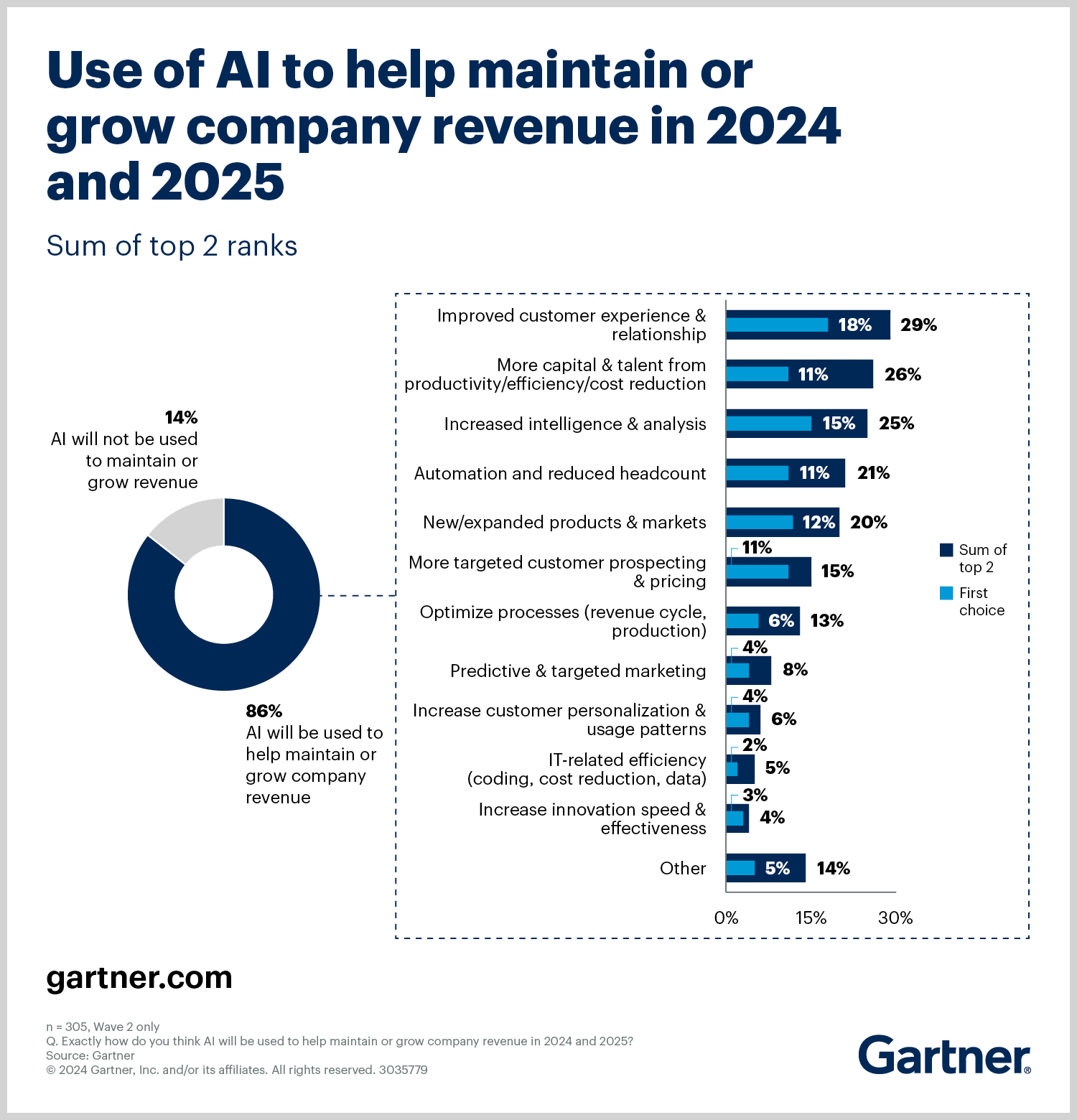
CEOs are vague on how AI will grow revenue
- Eighty-six percent of CEOs believe that this year and next, AI can help maintain or grow company revenue.
- When asked how, CEOs pointed to improving the customer experience, increasing talent productivity, and adding intelligence and analysis.
- This suggests CEOs are confusing general efficiency with winning revenue. It is only lower on the list that we find more direct and substantive revenue gain mechanisms such as new products, more targeted marketing and personalization.

Generative AI for Real-World Business Productivity
As some of the hype surrounding generative AI settles and we move through the trough of disillusionment, it’s time to delve into the real work ahead. In this seventh episode of Top of Mind, Gartner Chief of Research Chris Howard explores tangible and practical applications of GenAI that span industries and key business functions, including marketing, supply chain, finance and legal. Chris discusses how wide-ranging experiments and pilots in these spaces are paving the way for improved productivity and increased adoption of this groundbreaking technology.
Innovative Applications of Generative AI in Corporate Enterprises
Generative AI offers a multitude of applications across various corporate functions:
1. Code Generation
- Application: Software developers and programmers use generative AI to write code.
- Benefits: Experienced developers lean on generative AI to advance complex coding tasks more efficiently. It also plays a significant role in identifying and fixing bugs and automating code testing, ensuring the code meets quality standards without extensive manual effort.
- Example: GitHub Copilot, powered by OpenAI Codex, assists developers by suggesting code snippets, autocompleting lines, and generating entire functions based on comments and context within the code editor.
- Source: GitHub Copilot
2. Product Development
- Application: Product designers use generative AI to optimize design concepts on a large scale.
- Benefits: This technology streamlines the design process, ensuring products are strong, durable, and cost-effective. Product managers employ generative AI to synthesize user feedback, enabling product improvements directly influenced by user needs.
- Example: Autodesk’s generative design tool, used by Airbus to create lighter, more efficient airplane components. The AI generated numerous design iterations that optimized material usage and structural integrity.
- Source: Autodesk and Airbus
3. Sales and Marketing
- Application: Generative AI assists in creating hyper-personalized communication for marketing campaigns across various channels.
- Benefits: It boosts team performance by providing deep analytics and insights into customer behavior. Marketing departments use this technology to understand consumer behavior patterns and craft content that resonates with their audience.
- Example: Persado uses AI to generate personalized marketing messages that resonate with customers, improving engagement and conversion rates.
- Source: Persado
4. Project Management and Operations
- Application: Generative AI tools support project managers by automating task generation, leveraging historical data to forecast timelines, and predicting risks.
- Benefits: These tools allow project managers to focus on higher-level strategy rather than daily business management.
- Example: Asana uses AI to assist in task management, providing smart suggestions for task prioritization and project planning.
- Source: Asana
5. Graphic Design and Video
- Application: Generative AI creates realistic images and streamlines animation, allowing the creation of videos without actors or editing expertise.
- Benefits: AI video generators can produce videos in multiple languages, serving various regions effectively.
- Example: Synthesia uses AI to create professional videos with AI avatars, enabling content creation without the need for a camera or a crew.
- Source: Synthesia
6. Business and Employee Management
- Application: In customer service, generative AI makes documentation easy to access, improving case resolution efficiency.
- Benefits: It enhances employee-manager interactions by structuring performance reviews and providing feedback through conversational AI portals.
- Example: Lattice uses AI to help managers provide continuous performance feedback and create structured performance reviews.
- Source: Lattice
7. Customer Support and Customer Service
- Application: Generative AI advancements enable more innovative chatbots that understand context and nuance, providing 24/7 customer support.
- Benefits: These AI-powered chatbots handle customer inquiries around the clock, offering a seamless user experience.
- Example: Zendesk’s Answer Bot uses AI to provide instant answers to customer queries, improving response times and customer satisfaction.
- Source: Zendesk Answer Bot
8. Fraud Detection and Risk Management
- Application: Generative AI quickly scans and summarizes large amounts of data to identify patterns or anomalies.
- Benefits: It generates custom reports for underwriters and claims adjusters, saving time and simplifying decision-making.
- Example: Darktrace uses AI to detect and respond to cyber threats in real-time, protecting businesses from fraud and cyber attacks.
- Source: Darktrace
9. Generating Synthetic Data for Training and Testing
- Application: Enterprises use generative AI to create synthetic data for training models, testing products, and simulating real-world scenarios.
- Benefits: This reduces reliance on sensitive or expensive data sources, accelerating development cycles.
- Example: Mostly AI provides synthetic data solutions to create realistic, privacy-preserving datasets for AI model training.
- Source: Mostly AI
10. Content Creation and Management
- Application: Generative AI can create high-quality content for blogs, social media, and marketing materials.
- Benefits: It helps maintain a consistent brand voice and reduces the time required to produce content, allowing marketing teams to focus on strategy and engagement.
- Example: Jasper AI generates blog posts, social media content, and marketing copy, helping businesses streamline their content creation processes.
- Source: Jasper AI
11. Financial Modeling and Forecasting
- Application: Generative AI can create detailed financial models and forecasts based on historical data and market trends.
- Benefits: This assists finance teams in making more accurate predictions and informed decisions.
- Example: Tesorio uses AI to predict cash flow and manage working capital, helping businesses optimize their financial operations.
- Source: Tesorio
12. Human Resources and Recruitment
- Application: Generative AI can automate the recruitment process by screening resumes and generating interview questions.
- Benefits: It ensures a more efficient and unbiased selection process, helping HR teams identify the best candidates faster.
- Example: HireVue uses AI to analyze video interviews and assess candidate suitability, streamlining the hiring process.
- Source: HireVue
13. Legal Document Analysis and Drafting
- Application: Generative AI can analyze legal documents, draft contracts, and summarize case law.
- Benefits: This reduces the workload for legal teams, ensures accuracy and consistency in legal documentation, and speeds up the drafting process.
Examples:
- LawGeex: Uses AI to review contracts and automate legal workflows. It saves time on high-volume contract analysis for non-disclosure agreements, service agreements, and more. This tool helps create consistency across contracts and reduces the time and cost of the review process (ClickUp).
- Lexis+ AI: This tool by LexisNexis extracts, analyzes, and summarizes key insights from legal documents. It helps lawyers by pinpointing crucial information, generating summaries of lengthy documents, and streamlining the drafting of legal memos and letters (LexisNexis).
- LegalSifter: This AI tool generates first drafts of contracts, legal briefs, memos, and letters using templates and key inputs. It significantly improves productivity, allowing lawyers to focus on higher-level strategic tasks (Marketing Scoop).
- Amto: Uses generative AI based on ChatGPT to draft various legal documents, including service agreements, work-for-hire contracts, and arbitration agreements. It also highlights sections of text for instant revisions and provides recommendations for missing clauses or gaps in legal research (ClickUp).
- Kira Systems: Enables automatic contract review to identify key clauses, obligations, rights, and risks. This tool is known for its high accuracy and is used by over 500 enterprises to expedite the contract analysis process (Marketing Scoop).
These examples demonstrate how generative AI is transforming legal workflows by automating repetitive tasks, improving accuracy, and allowing legal professionals to focus on more complex, strategic work. Tools like LawGeex, Lexis+ AI, LegalSifter, Amto, and Kira Systems are at the forefront of this transformation, providing tangible benefits to legal teams around the world.
14. Supply Chain Optimization
- Application: Generative AI can optimize supply chain operations by predicting demand, managing inventory, and identifying potential disruptions.
- Benefits: It enhances efficiency and reduces costs by ensuring a more responsive and resilient supply chain.
- Example: ClearMetal uses AI to provide real-time visibility into supply chain operations, optimizing logistics and inventory management.
- Source: ClearMetal
15. Healthcare Diagnostics and Treatment Planning
- Application: Generative AI can assist in diagnosing diseases and planning treatments by analyzing medical data and patient history.
- Benefits: This improves the accuracy of diagnoses and personalization of treatment plans, enhancing patient outcomes.
- Example: PathAI uses AI to analyze pathology slides and assist in diagnosing diseases, improving the accuracy and speed of medical diagnoses.
- Source: PathAI
16. Customer Experience Enhancement
- Application: Generative AI can personalize customer interactions by analyzing customer data and predicting preferences.
- Benefits: It improves customer satisfaction and loyalty by providing tailored experiences and solutions.
- Example: Dynamic Yield uses AI to personalize website content and recommendations, enhancing the customer experience.
- Source: Dynamic Yield
17. Energy Management
- Application: Generative AI can optimize energy usage in corporate facilities by predicting consumption patterns and suggesting efficiency measures.
- Benefits: This reduces energy costs and supports sustainability initiatives.
- Example: GridPoint uses AI to monitor and manage energy usage in commercial buildings, optimizing energy efficiency.
- Source: GridPoint
18. Retail and E-commerce Personalization
- Application: Generative AI can analyze shopping behavior and personalize recommendations for online shoppers.
- Benefits: It enhances the shopping experience and increases sales through targeted marketing.
- Example: Amazon’s recommendation engine uses AI to suggest products based on browsing and purchase history, improving customer satisfaction and sales.
- Source: Amazon AI
Real-World Case Studies: Generative AI Transformations in Corporate Enterprises
Several companies have already begun to harness the power of generative AI to transform their operations:
1-Accenture
- Application: Accenture is helping clients implement generative AI for smarter business strategies, automated document summarization, and cognitive search.
- Example: Spain’s Ministry of Justice uses Accenture’s AI-powered search engine, Delfos, to streamline judicial information access, making it easier for legal professionals to find and process judicial information.
- Source: Accenture’s AI solutions
2-Nvidia
- Application: Nvidia’s BioNeMo Drug Discovery Cloud Service accelerates drug discovery and research in life sciences.
- Example: Researchers use Nvidia’s cloud APIs to create custom biomolecular AI models, significantly speeding up early drug discovery pipelines.
- Source: Nvidia BioNeMo
3-Expedia
- Application: Expedia’s ChatGPT-powered travel planner provides personalized travel recommendations.
- Example: Users can ask questions and get recommendations on travel, lodging, and activities, streamlining the travel planning process and improving customer experience.
- Source: Expedia’s AI integration
4-Shopify
- Application: Shopify’s Magic tool helps retailers generate product descriptions and other content using AI.
- Example: This tool enhances the efficiency and quality of e-commerce operations, allowing businesses to scale content creation seamlessly.
- Source: Shopify Magic
5-Stripe
- Application: Stripe uses GPT-4 to improve documentation and query management for developers using Stripe Docs.
- Example: The tool helps summarize and extract important content, making information more accessible to users.
- Source: Stripe and OpenAI
6-Unilever
- Application: Unilever create a bot, Dove’s AI-powered Scalp + Hair Therapist. Users start by answering questions about their scalp health and hair concerns. The tool, developed using generative AI capabilities and drawing on a wealth of expertise from Dove’s dermatologists, then generates a personalised scalp and hair profile, and shares products that could help make a difference.
- Example: The AI tools analyze consumer data and generate tailored content, significantly improving engagement and conversion rates.
- Source: Unilever’s AI usage
7-Procter & Gamble
- Application: Procter & Gamble utilizes generative AI for product design and development.
- Example: The company uses AI to generate and test various design concepts, optimizing product features and reducing time-to-market and costs associated with physical prototypes.
- Source: P&G’s digital innovation
8-Coca-Cola
- Application: Coca-Cola leverages generative AI to create dynamic marketing content.
- Example: The AI system generates unique advertisements and social media posts that cater to different target demographics, enhancing brand reach and resonance.
- Source: Coca-Cola’s AI initiatives
9-BMW
- Application: BMW uses generative AI in the design phase of new vehicles.
- Example: The AI generates multiple design iterations based on specific parameters, allowing designers to explore innovative concepts quickly and efficiently.
- Source: BMW and AI
10-Pfizer
- Application: Pfizer incorporates generative AI in drug discovery processes.
- Example: The AI models analyze vast datasets to identify potential drug candidates, predict their interactions, and suggest modifications to improve efficacy and reduce side effects.
- Source: Pfizer’s AI research
11-IBM Watson
- Application: IBM Watson’s AI capabilities are employed in financial institutions to generate synthetic data for testing and training purposes.
- Example: This helps safeguard sensitive information while enabling comprehensive scenario simulations.
- Source: IBM Watson in finance
12-Adobe
- Application: Adobe’s generative AI tools, like Adobe Sensei, assist creative professionals by automating repetitive tasks.
- Example: These tools help in image editing and video production, allowing artists to focus on more creative aspects of their work.
- Source: Adobe Sensei
13-JPMorgan Chase
- Application: JPMorgan Chase uses generative AI for fraud detection and risk management.
- Example: The AI system analyzes transaction data to detect anomalies and generate alerts for suspicious activities, enhancing financial security.
- Source: JPMorgan’s AI initiatives
14-Shell
- Application: Shell leverages generative AI for predictive maintenance in its oil rigs.
- Example: The AI models generate maintenance schedules and identify potential equipment failures before they occur, reducing downtime and operational costs.
- Source: Shell’s AI applications
15-Netflix
- Application: Netflix employs generative AI to personalize content recommendations for users.
- Example: By analyzing viewing habits and preferences, the AI generates tailored suggestions, enhancing user satisfaction and engagement.
- Source: Netflix’s AI usage
16-Amazon
- Application: Amazon uses generative AI to optimize logistics and supply chain operations.
- Example: The AI models generate efficient routing plans, predict inventory needs, and automate warehouse management tasks.
- Source: Amazon’s AI logistics
17-Ford
- Application: Ford integrates generative AI into its manufacturing processes to design more efficient and lighter vehicle components.
- Example: The AI-generated designs undergo simulation testing to ensure they meet safety and performance standards.
- Source: Ford’s AI in manufacturing
18-Siemens
- Application: Siemens employs generative AI for smart manufacturing.
- Example: The AI systems generate process optimization plans, predict equipment maintenance needs, and improve overall production efficiency.
- Source: Siemens AI solutions
19-Microsoft
- Application: Microsoft uses generative AI in its Azure platform to enhance various business processes and applications, including content creation and design, software development, customer support, healthcare, retail, and office productivity. Generative AI automates high-quality content creation, such as images and videos, through platforms like Typeface, and assists developers with code suggestions using GitHub Copilot. It enhances customer interactions in Microsoft Teams and Power Virtual Agents, automates IT tasks and HR processes for companies like AT&T, and analyzes medical data for personalized healthcare solutions. Retailers like Walmart leverage it for personalized shopping experiences. Additionally, Microsoft 365 Copilot integrates generative AI into Office applications like Word, Excel, PowerPoint, Outlook, and Teams, aiding in drafting documents, creating presentations, analyzing data, and summarizing emails and meetings, thereby streamlining work processes and improving productivity
- Example: These AI-powered features help developers write cleaner, more efficient code faster.
- Sources: (Building for the future: The enterprise generative AI application lifecycle with Azure AI) (Welcoming the generative AI era with Microsoft Azure) (Microsoft Learn) (From code to production: New ways Azure helps you build transformational AI experiences) (Empowering operators through generative AI technologies with Azure for Operators) (Azure OpenAI Service: 10 ways generative AI is transforming businesses) (The Official Microsoft Blog) (Microsoft Cloud) (Microsoft Cloud) (Microsoft Learn) (Voicebot.ai).
20-Tesla
- Application: Tesla incorporates generative AI in its autonomous driving technology.
- Example: The AI models generate and test various driving scenarios, enhancing the safety and reliability of Tesla’s self-driving cars.
- Source: Tesla’s AI development
The Future of Generative AI: key trends and predictions
The future of generative AI in the corporate world is promising, with continuous advancements expected to unlock new capabilities. According to McKinsey, generative AI may significantly advance by 2040, potentially competing with the top 25% of human performers across various tasks. This means AI could write high-quality content, solve complex problems, and make insightful business decisions on par with skilled professionals.
As AI technology progresses, integrating perceptual systems into AI could enable it to mimic human senses like touch and smell, moving beyond the focus on language and imagery. This advancement could lead to AI models surpassing human capabilities in emotional recognition, offering deeper insights into human emotions.
However, bias in generative AI models will remain a challenge, giving rise to new marketplaces centered around ethical data sets. As generative AI tools become more widespread, they will inevitably bring changes to job roles and require new skills. Increased misuse of generative capabilities is also anticipated, underscoring the importance of robust mechanisms to mitigate risks and ensure responsible use of AI technologies.
Generative AI will continue transforming enterprise operations across various industries, much like the smartphone transformed business communication and productivity. From automating mundane tasks to fostering creativity in content creation, the potential of generative AI is vast and varied. However, navigating ethical considerations, maximizing data security, and adapting to evolving best practices are paramount.
By 2027, more than 50% of the GenAI models that enterprises use will be specific to either an industry or business function — up from approximately 1% in 2023.
- Although general-purpose models perform well across a broad set of applications, demand for GenAI is rising in many sectors. Combined with increased availability of high-performing and commercially usable open-source LLMs, there is an appetite for domain-specific models.
- Domain models can be smaller, less computationally intensive and lower the hallucination risks associated with general-purpose models.
- Plan for the need to deploy and manage multiple domain-specific GenAI models to support a variety of use cases. But before you build your own, look for off-the-shelf, domain-specific models you can train or tune to accommodate your enterprise needs.
By 2026, 75% of businesses will use generative AI to create synthetic customer data, up from less than 5% in 2023.
- Development of synthetic — i.e., artificially generated — data supports systems where real data is expensive, unavailable, imbalanced or unusable because of privacy regulations.
- Introducing synthetic data into models enables organizations to simulate environments and identify new product development opportunities, especially in highly regulated industries. It also enables fast prototyping of software, digital and hybrid experiences.
- Focus use of synthetic data in areas that directly correlate to business growth, such as the development of customer segments, journeys and experiences and training of machine learning models.
By 2028, 30% of GenAI implementations will be optimized using energy-conserving computational methods, driven by sustainability initiatives.
- The rapid adoption of generative AI tools has made the negative environmental impact of GenAI, which the public and governments are calling out, an immediate concern for business leaders.
- Minimizing the energy and resources required for AI training and development is critical. Renewable energy and infrastructure for both on-premises and cloud services will be customized for AI.
- Control costs for energy-optimized compute resources by diversifying your suppliers, pursuing composable architecture and edge operations for GenAI in each jurisdiction of operation, and using high-quality renewable energy during training to mitigate its impact on your sustainability goals.
Some may worry about AI taking over our lives and jobs, but it’s just like the Internet in the last century — a powerful tool that we simply need to learn, adapt to, and embrace. Ignoring it will not make it go away. With that in mind, let’s delve into the key trends and predictions that lie ahead for this remarkable technology.

Generative AI has come to various industries, reshaping the realms of creativity, productivity, and problem-solving. The following figures will provide you with further insights into the impact of gen-AI across different sectors.

Conclusion
Generative AI is not just an incremental advancement; it represents a paradigm shift in how businesses operate, innovate, and compete. As highlighted throughout this blog post, generative AI’s ability to automate complex tasks, enhance creativity, and provide deep insights is revolutionizing the corporate landscape. From code generation to personalized marketing, the applications of generative AI are diverse and transformative, driving unprecedented levels of efficiency and innovation. The case studies discussed demonstrate how leading companies are leveraging this technology to gain a competitive edge, showcasing the tangible benefits and strategic value it offers.
However, embracing generative AI comes with its set of challenges and responsibilities. Ethical considerations, data privacy, and the environmental impact of AI development are critical issues that need to be addressed to ensure sustainable and responsible adoption. Companies must establish robust AI governance frameworks and stay vigilant about potential biases in AI models. By doing so, they can mitigate risks and maximize the benefits, fostering a culture of ethical AI deployment and continuous innovation.
Looking ahead, the future of generative AI in the corporate world is incredibly promising. With ongoing advancements and increasing domain-specific applications, generative AI will become an integral part of various industries, transforming processes and driving growth. As businesses navigate this AI-driven revolution, it is crucial to embrace generative AI, adapt to its evolving landscape, and harness its full potential. By doing so, they can create lasting value, enhance productivity, and revolutionize the way they operate, ensuring they remain at the forefront of innovation in an increasingly competitive world.
That’s it for today!
Sources
https://www.eweek.com/artificial-intelligence/generative-ai-enterprise-use-cases/
https://itrexgroup.com/blog/generative-ai-use-cases-in-business/
https://tovie.ai/blog/7-real-world-use-cases-of-generative-ai-for-business
https://www2.deloitte.com/content/dam/Deloitte/us/Documents/consulting/us-ai-institute-gen-ai-use-cases.pdf
https://www.skillreactor.io/blog/generative-ai-use-cases/
https://pixelplex.io/blog/generative-ai-market-map/
https://www.gartner.com/en/articles/3-bold-and-actionable-predictions-for-the-future-of-genai
https://www.gartner.com/en/articles/how-your-ceo-is-thinking-about-ai